By journalist and author, Dylan Jones OBE / @dylanjones
Debbie Harry arrived from both the future and the past at the very same time. At least that’s what it seemed like. Blondie, the band she formed with her significant other Chris Stein in 1974, appeared without any great fanfare. But at the tail end of 1976, when punk was starting to bubble up on the Bowery sidewalk outside CBGBs, she seemed to rise above the crowds of leather jackets and practised scowls, like steam from the Manhattan Subway.
She was patently a star before she opened her mouth, a walking, talking trademark.
With her feathery platinum blonde hair, spray-on micro-skirts, gigantic heels (she was always teeny tiny) and melodic conversational voice, she instantly became the most acceptable punk pin-up, an immediate icon whose appeal was both metaphorical and literal. Here was a Marilyn for the punk generation, a raggle-taggle sex bomb who thought the whole idea of being a sex bomb was fantastically silly but actually quite fun. Rather wonderfully, she never tried to hide the fact that her iconographic hair was dyed; she was a punk, after all, and on the cover of the first Blondie LP you can clearly see her mousy brown roots. Blondie’s tongue was firmly in its collective cheek, and so was Harry’s. Even their name was a giveaway – a band called Blondie fronted by a girl who obviously wasn’t. Debbie Harry – Deborah to her friends - may have been a sex kitten, but she was certainly no bimbo and set about exploiting her sexuality before anyone else got a chance.
From the beginnings of the group, Harry was always toying with the ambiguity of pop iconography and the implications of sexual role-playing. The endless Monroe comparisons were taken with liberal pinches of Margarita salt, with Harry always amused that she had been imagined as a global wet dream when all she really wanted was a square meal.
When you saw her in the flesh – propping up the bar in the Marquee Street, or onstage at the Hammersmith Odeon, she looked otherworldly. When you bumped into the likes of Siouxsie Sioux, Jordan, Soo Catwoman, or any of the other female punk “faces”, there was always a frisson of confrontation. With Harry, she seemed to naturally semaphore a benign sexuality, a sensational hark back to the past, with a neon, fluorescent nod to some kind of mediated leopard skin future.
![]()
 Debbie Harry of Blondie. New York, 1970s. (Photo by Anthony Barboza/Getty Images)
![]() "She seemed to rise above the crowds of leather jackets and practised scowls, like steam from the Manhattan Subway."
"She seemed to rise above the crowds of leather jackets and practised scowls, like steam from the Manhattan Subway."![]()
And oh my word, she was gorgeous, a woman who had an ability to say so much without even speaking. She could tell a story just be shaking her hair, but she could say so much more with her eyes. Harry’s eyes were almost as mesmeric as her hair, hypnotic peepers framed with spider lashes and thick smoky eyeshadow, icy electric blue disco eyes which always seemed to have a life of their own.
She was also a genuine icon, during a period when the word was starting to be terribly abused. Before the colossal creative turbulence of the Sixties, when the West started to be shaken up by the confluence of art, music, fashion and theatrics, icons were few and very far between. There was Elvis, Marilyn, James Dean, Charlie Chaplin, Marlon Brando and Rudolph Valentino (when the silent movie star died, over 100,000 people lined the streets of Manhattan to pay their respects at his funeral), 20th Century bold-faced names whose fame acted as a global panacea. They were mostly American, or became famous in America, new stars for a new country. But as the expanding worlds of Hollywood, television and pop collided with an equally rapacious media landscape, fame became a byproduct of success, the transactional result of ubiquity. Which meant there was a new icon born every five minutes, only to be eclipsed by another one five minutes later.
Harry was different, as she combined so many contrasting and complimentary ideas: of course she had a shock of obviously and deliberately dyed blonde hair, but she looked like a movie star, dressed like a runway model, spoke like a radio host (a funny radio host), and had a healthy dose of sass. The Debbie Harry she created for Blondie was an exaggerated version of herself, even before she became famous, which obviously showed enormous foresight. In the autobiography Face It, she describes the character she created with Blondie as being androgynous. This surprised a lot of people, as she always seemed to deliberately look like a sex bomb.
"Here was a Marilyn for the punk generation, a raggle-taggle sex bomb who thought the whole idea of being a sex bomb was fantastically silly but actually quite fun."
“The Blondie character I created was always meant to be androgynous,” she told me, when I interviewed her on its release, seven years ago. “Obviously, I don’t think that I am physically androgynous, but I think that mentally my feelings about sexuality have always been very, how would I say it, conflicted, so I wanted ‘Blondie’ to have more supposedly male traits. I’ve always been frustrated by the idea that I grew up in an era when women were not expected to have a career or to have strong opinions. I felt akin to a more liberal mentality, and I always felt angry about being told, ‘Oh, you can’t do that because you’re a girl.’ I mean also mentally I had capabilities and the drive that most men had and had been given this authority to have that. The idea of not having that authority was something that probably pushed me into being a punk. It might not have looked like it at the time, but I was all about androgyny.”
In the book she also talked about how she was photographed in the early days, and the fact that the version of herself that she amplified was a sort of meta version of a character, a cartoon version of a pin-up.
“My character in Blondie was partly a visual homage to Marilyn, and partly a statement about the good old double standard,” she said. “From the first time I set eyes on Marilyn, I thought she was wonderful. On the silver screen, her lovely skin and platinum hair were luminescent and fantastic. I loved the fantasy of it. Marilyn was an enormous star, but there was such a double standard. The fact she was such a hot number meant many middle-class women looked on her as a slut. And since the publicity machine sold her as a sex idol, she wasn’t given credit for her talent. I felt Marilyn was also playing a character, the proverbial dumb blonde with the little-girl voice and big-girl body, and that there was a lot of smarts behind the act.”
Harry had the smarts.
“Too often photographers went for the lowest common denominator,” she told me. “It was a tricky position for me because I did appreciate creating this kind of image, and I feel it’s a sort of art form in its way, and as an actor bringing a character to life, to bring this kind of cartoon, if you want to call it a fetish cartoon kind of character, to life was maybe an art form. I have always enjoyed doing that. I’ve enjoyed characterisations and dressing up and creating these characters is something I really enjoy doing. It’s sort of been an underpinning of my aesthetic in my performances.”
 Debbie Harry and Chris Stein of Blondie, New York, 1979. (Photo by Roberta Bayley/Getty Images)
Of course, in a sense she was lucky as she was part of a generation which treated celebrity with great ambivalence. Because while the likes of Joe Strummer, Billy Idol, Johnny Rotten, Poly Styrene and Paul Weller – some of the most prominent anti-heroes of punk – professed to hate what they considered to be the manufactured constraints of fame, they all soon fell victim to the same media temptations. They all became icons, and deservedly so.
Harry also had one hell of a back story, a seemingly purpose-built resume that made her even more exotic than she appeared to be when the press first started writing about her. Harry was born Angela Trimble on July 1, 1945, at the Jackson Memorial Hospital in Miami, Florida; by the time she became famous she was already in her early thirties. After three months, she was adopted and renamed Deborah Ann Harry by Catherine and Richard Harry, of Hawthorne, in New Jersey. She has said she developed write a fear of abandonment which she also says she still has: “I guess somewhere in my subconscious; a scene was playing on a loop of a parent leaving me somewhere and never coming back.” As a girl, she survived being in a coma as a result of pneumonia. A tomboy, she was a natural performer, and moved to Manhattan in the late Sixties, failing at auditions before becoming a waitress at Max’s Kansas City, a go-go dancer in a disco in Union City, a chauffeur for the New York Dolls, and even a Playboy Bunny before becoming embroiled in the downtown CBGBs scene of the early Seventies – hanging out with David Bowie, Lou Reed, Patti Smith, Iggy Pop, the Ramones, Television, Talking Heads and Andy Warhol (who would later immortalise her killer cheekbones and perfect, heart-shaped mouth in a famous portrait). Those early hardscrabble years in New York included an appalling rape at knifepoint, an attempted abduction by serial killer Ted Bundy, and an early dabble with heroin (something which she would revisit with some gusto in the Eighties).She loved the Seventies, though: “Everybody was living in squats and everything; it was kind of romantic… We were struggling but we were happy.”
Her iconic status was rubberstamped by her talent, and Blondie’s ability to pump out hit after hit after hit, between 1978 and 1982 releasing “Sunday Girl”, “In The Flesh”, “Denis”, “(I’m Always Touched By Your) Presence, Dear”, “Picture This”, “I’m Gonna Love You Too”, “Hanging On The Telephone”, “One Way Or Another”, “Dreaming”, “Union City Blue”, “Call Me”, “Atomic”, “The Tide Is High”, “Rapture” and, of course, the monster of all monsters, the extraordinary “Heart Of Glass”, a punky disco fusion which conquered the world. The music mirrored her image, a bright, spangly, old-fashioned type of pop which even when it sounded nostalgic always felt as though it had been channelled through some kind of retro-futuristic blender. In a good way. Like all good pop, it was heightened, it was glossy, and – obviously – it was ridiculously popular.
 From left, Gary Valentine, Clem Burke, Debbie Harry, Chris Stein, and Jimmy Destri of Blondie. (Photo from Bettmann/Getty Images)
Blondie were as famous in the UK as they were in the US – sometime more so, and her own personal adulation gave them a tabloid presence as well as a music press profile. Harry described fame as being in a sort of rocket hurtling through space, bound for God knows where.
“Success in Britain came as a huge boost even though it wasn’t completely a surprise,” she told me. “I mean, we did lay some foundation and groundwork, but I think the spirit of the whole time was much brighter and more active in the UK than it was in the US. The atmosphere in the UK was great and it just sort of created this wonderful ambiance throughout the whole country and it was just a new experience for us because our country was so regional at the time, we didn’t have a unified presentation of what the music scene was. So, when we got to the UK and we first experienced this, it was extraordinary. At one point I even started to feel British.”
We felt like she was British, too, which gave her an approachable aspect; not only did she look like a goddess, but she looked like one you could talk to. I remember seeing her one night in Dingwalls, Camden’s legendary live music venue in late 1977, early 1978, surrounded by journalists, musicians and fans, and she looked as though she had been beamed down from somewhere far godlier (in the late Seventies there were few London venues which were less godly than Dingwalls). She looked both extraordinarily normal and quintessentially special, almost as though she were in costume. Which, in a way, I suppose she was. Even when she was dressed in casual clothes, she looked as though she was ready for the stage. I saw her once at a house party in East London in the Noughties, and even though she was wearing a gargantuan overcoat, there was something about her presence which made you think she could burst into song at any moment. And get away with it.
"She was also a genuine icon, during a period when the word was starting to be terribly abused."
She also knew the effect she had on people, but not in a necessarily conceited way. She wasn’t one for making grand entrances unless the occasion demanded it, and even then, she was a reluctant offstage performer. However, she knew the importance of the band’s success, and how their celebrity in the UK was part of a bigger musical story, one which had begun back in the Swinging Sixties. As fame started to envelope Blondie, she quickly learned to accept it and soon, even enjoy it.
“It was weird, because so much was happening in London at the time, but when you’re riding a success like we were with Blondie, it’s hard to keep up with everything,” she told me. “You’re in the middle of all this crazy activity and you just hang on for dear life. What I do know is that it was especially wonderful being in London. We’d all been aware of The Beatles and The Stones, and as music is such an important part of British culture, it felt great to play such an important part in it.”
 Debbie Harry and Blondie, Netherlands, 1978. (Photo by Lex van Rossen/Getty Images)
Harry knew how to turn it on, even if she wasn’t always complicit. The photographer Martyn Goddard once spent a week with the band in the Gramercy Park hotel in the late Seventies, when they were morphing swiftly from a band which played clubs to a phenomenon which played arenas. “You pressed the button, and she just transformed into a model,” he said. “You didn’t really need to direct her. She came up with the most wonderful poses.”
I hosted her at the legendary GQ Men of the Year Awards on many occasions, and she was never less than a delight to work with. She was always chatty, always accommodating, and even if she was a little grumpy, she always apologised. Whereas other legacy stars, or so-called icons were difficult, demanding, grabby or simply downright rude (one ex-James Bond girl even demanded an appearance fee just hours before she was due on stage), Harry never took her invitations for granted, and always behaved like a lady when she turned up. Like an icon, in fact. A real icon. The last time she came, in 2019, which was the last year the awards were held with such grandeur (and where she was presenting a Lifetime Achievement award to her old friend Iggy Pop), she looked suitably iconoclastic – wearing a complicated black and red ensemble, huge red stacked sci-fi heels and a pair of jet-black evening sunglasses. She also wore a big Debbie Harry smile.
That night, like many others, she was the belle of the ball, an iconic belle at that.
A Note from Cutler and Gross
Dylan Jones OBE is an English journalist and author, notable for his time as Editor of GQ magazine from 1999-2021, and roles within publications including Evening Standard, i-D, Arena and The Independent.
Jones has written New York Times and Sunday Times bestselling books on music, politics and fashion, including David Bowie: A Life and Faster Than a Cannonball: 1995 and All That. Through work and personal life, Jones has formed lifelong friendships with notable names such as Tracey Emin OBE, Deborah Harry and the late David Bowie.
Cutler and Gross would like to express gratitude to Dylan Jones for his insight into the life and legacy of Debbie Harry.











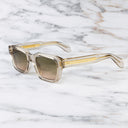

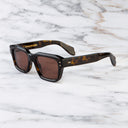
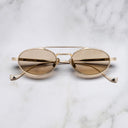
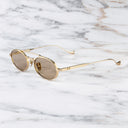
















Blonde Roots: Deborah Harry is The Icon Sublime
By journalist and author, Dylan Jones OBE / @dylanjones
Debbie Harry arrived from both the future and the past at the very same time. At least that’s what it seemed like. Blondie, the band she formed with her significant other Chris Stein in 1974, appeared without any great fanfare. But at the tail end of 1976, when punk was starting to bubble up on the Bowery sidewalk outside CBGBs, she seemed to rise above the crowds of leather jackets and practised scowls, like steam from the Manhattan Subway.
She was patently a star before she opened her mouth, a walking, talking trademark.
With her feathery platinum blonde hair, spray-on micro-skirts, gigantic heels (she was always teeny tiny) and melodic conversational voice, she instantly became the most acceptable punk pin-up, an immediate icon whose appeal was both metaphorical and literal. Here was a Marilyn for the punk generation, a raggle-taggle sex bomb who thought the whole idea of being a sex bomb was fantastically silly but actually quite fun. Rather wonderfully, she never tried to hide the fact that her iconographic hair was dyed; she was a punk, after all, and on the cover of the first Blondie LP you can clearly see her mousy brown roots. Blondie’s tongue was firmly in its collective cheek, and so was Harry’s. Even their name was a giveaway – a band called Blondie fronted by a girl who obviously wasn’t. Debbie Harry – Deborah to her friends - may have been a sex kitten, but she was certainly no bimbo and set about exploiting her sexuality before anyone else got a chance.
From the beginnings of the group, Harry was always toying with the ambiguity of pop iconography and the implications of sexual role-playing. The endless Monroe comparisons were taken with liberal pinches of Margarita salt, with Harry always amused that she had been imagined as a global wet dream when all she really wanted was a square meal.
When you saw her in the flesh – propping up the bar in the Marquee Street, or onstage at the Hammersmith Odeon, she looked otherworldly. When you bumped into the likes of Siouxsie Sioux, Jordan, Soo Catwoman, or any of the other female punk “faces”, there was always a frisson of confrontation. With Harry, she seemed to naturally semaphore a benign sexuality, a sensational hark back to the past, with a neon, fluorescent nod to some kind of mediated leopard skin future.
And oh my word, she was gorgeous, a woman who had an ability to say so much without even speaking. She could tell a story just be shaking her hair, but she could say so much more with her eyes. Harry’s eyes were almost as mesmeric as her hair, hypnotic peepers framed with spider lashes and thick smoky eyeshadow, icy electric blue disco eyes which always seemed to have a life of their own.
She was also a genuine icon, during a period when the word was starting to be terribly abused. Before the colossal creative turbulence of the Sixties, when the West started to be shaken up by the confluence of art, music, fashion and theatrics, icons were few and very far between. There was Elvis, Marilyn, James Dean, Charlie Chaplin, Marlon Brando and Rudolph Valentino (when the silent movie star died, over 100,000 people lined the streets of Manhattan to pay their respects at his funeral), 20th Century bold-faced names whose fame acted as a global panacea. They were mostly American, or became famous in America, new stars for a new country. But as the expanding worlds of Hollywood, television and pop collided with an equally rapacious media landscape, fame became a byproduct of success, the transactional result of ubiquity. Which meant there was a new icon born every five minutes, only to be eclipsed by another one five minutes later.
Harry was different, as she combined so many contrasting and complimentary ideas: of course she had a shock of obviously and deliberately dyed blonde hair, but she looked like a movie star, dressed like a runway model, spoke like a radio host (a funny radio host), and had a healthy dose of sass. The Debbie Harry she created for Blondie was an exaggerated version of herself, even before she became famous, which obviously showed enormous foresight. In the autobiography Face It, she describes the character she created with Blondie as being androgynous. This surprised a lot of people, as she always seemed to deliberately look like a sex bomb.
“The Blondie character I created was always meant to be androgynous,” she told me, when I interviewed her on its release, seven years ago. “Obviously, I don’t think that I am physically androgynous, but I think that mentally my feelings about sexuality have always been very, how would I say it, conflicted, so I wanted ‘Blondie’ to have more supposedly male traits. I’ve always been frustrated by the idea that I grew up in an era when women were not expected to have a career or to have strong opinions. I felt akin to a more liberal mentality, and I always felt angry about being told, ‘Oh, you can’t do that because you’re a girl.’ I mean also mentally I had capabilities and the drive that most men had and had been given this authority to have that. The idea of not having that authority was something that probably pushed me into being a punk. It might not have looked like it at the time, but I was all about androgyny.”
In the book she also talked about how she was photographed in the early days, and the fact that the version of herself that she amplified was a sort of meta version of a character, a cartoon version of a pin-up.
“My character in Blondie was partly a visual homage to Marilyn, and partly a statement about the good old double standard,” she said. “From the first time I set eyes on Marilyn, I thought she was wonderful. On the silver screen, her lovely skin and platinum hair were luminescent and fantastic. I loved the fantasy of it. Marilyn was an enormous star, but there was such a double standard. The fact she was such a hot number meant many middle-class women looked on her as a slut. And since the publicity machine sold her as a sex idol, she wasn’t given credit for her talent. I felt Marilyn was also playing a character, the proverbial dumb blonde with the little-girl voice and big-girl body, and that there was a lot of smarts behind the act.”
Harry had the smarts.
“Too often photographers went for the lowest common denominator,” she told me. “It was a tricky position for me because I did appreciate creating this kind of image, and I feel it’s a sort of art form in its way, and as an actor bringing a character to life, to bring this kind of cartoon, if you want to call it a fetish cartoon kind of character, to life was maybe an art form. I have always enjoyed doing that. I’ve enjoyed characterisations and dressing up and creating these characters is something I really enjoy doing. It’s sort of been an underpinning of my aesthetic in my performances.”
Of course, in a sense she was lucky as she was part of a generation which treated celebrity with great ambivalence. Because while the likes of Joe Strummer, Billy Idol, Johnny Rotten, Poly Styrene and Paul Weller – some of the most prominent anti-heroes of punk – professed to hate what they considered to be the manufactured constraints of fame, they all soon fell victim to the same media temptations. They all became icons, and deservedly so.
Harry also had one hell of a back story, a seemingly purpose-built resume that made her even more exotic than she appeared to be when the press first started writing about her. Harry was born Angela Trimble on July 1, 1945, at the Jackson Memorial Hospital in Miami, Florida; by the time she became famous she was already in her early thirties. After three months, she was adopted and renamed Deborah Ann Harry by Catherine and Richard Harry, of Hawthorne, in New Jersey. She has said she developed write a fear of abandonment which she also says she still has: “I guess somewhere in my subconscious; a scene was playing on a loop of a parent leaving me somewhere and never coming back.” As a girl, she survived being in a coma as a result of pneumonia. A tomboy, she was a natural performer, and moved to Manhattan in the late Sixties, failing at auditions before becoming a waitress at Max’s Kansas City, a go-go dancer in a disco in Union City, a chauffeur for the New York Dolls, and even a Playboy Bunny before becoming embroiled in the downtown CBGBs scene of the early Seventies – hanging out with David Bowie, Lou Reed, Patti Smith, Iggy Pop, the Ramones, Television, Talking Heads and Andy Warhol (who would later immortalise her killer cheekbones and perfect, heart-shaped mouth in a famous portrait). Those early hardscrabble years in New York included an appalling rape at knifepoint, an attempted abduction by serial killer Ted Bundy, and an early dabble with heroin (something which she would revisit with some gusto in the Eighties).She loved the Seventies, though: “Everybody was living in squats and everything; it was kind of romantic… We were struggling but we were happy.”
Her iconic status was rubberstamped by her talent, and Blondie’s ability to pump out hit after hit after hit, between 1978 and 1982 releasing “Sunday Girl”, “In The Flesh”, “Denis”, “(I’m Always Touched By Your) Presence, Dear”, “Picture This”, “I’m Gonna Love You Too”, “Hanging On The Telephone”, “One Way Or Another”, “Dreaming”, “Union City Blue”, “Call Me”, “Atomic”, “The Tide Is High”, “Rapture” and, of course, the monster of all monsters, the extraordinary “Heart Of Glass”, a punky disco fusion which conquered the world. The music mirrored her image, a bright, spangly, old-fashioned type of pop which even when it sounded nostalgic always felt as though it had been channelled through some kind of retro-futuristic blender. In a good way. Like all good pop, it was heightened, it was glossy, and – obviously – it was ridiculously popular.
Blondie were as famous in the UK as they were in the US – sometime more so, and her own personal adulation gave them a tabloid presence as well as a music press profile. Harry described fame as being in a sort of rocket hurtling through space, bound for God knows where.
“Success in Britain came as a huge boost even though it wasn’t completely a surprise,” she told me. “I mean, we did lay some foundation and groundwork, but I think the spirit of the whole time was much brighter and more active in the UK than it was in the US. The atmosphere in the UK was great and it just sort of created this wonderful ambiance throughout the whole country and it was just a new experience for us because our country was so regional at the time, we didn’t have a unified presentation of what the music scene was. So, when we got to the UK and we first experienced this, it was extraordinary. At one point I even started to feel British.”
We felt like she was British, too, which gave her an approachable aspect; not only did she look like a goddess, but she looked like one you could talk to. I remember seeing her one night in Dingwalls, Camden’s legendary live music venue in late 1977, early 1978, surrounded by journalists, musicians and fans, and she looked as though she had been beamed down from somewhere far godlier (in the late Seventies there were few London venues which were less godly than Dingwalls). She looked both extraordinarily normal and quintessentially special, almost as though she were in costume. Which, in a way, I suppose she was. Even when she was dressed in casual clothes, she looked as though she was ready for the stage. I saw her once at a house party in East London in the Noughties, and even though she was wearing a gargantuan overcoat, there was something about her presence which made you think she could burst into song at any moment. And get away with it.
She also knew the effect she had on people, but not in a necessarily conceited way. She wasn’t one for making grand entrances unless the occasion demanded it, and even then, she was a reluctant offstage performer. However, she knew the importance of the band’s success, and how their celebrity in the UK was part of a bigger musical story, one which had begun back in the Swinging Sixties. As fame started to envelope Blondie, she quickly learned to accept it and soon, even enjoy it.
“It was weird, because so much was happening in London at the time, but when you’re riding a success like we were with Blondie, it’s hard to keep up with everything,” she told me. “You’re in the middle of all this crazy activity and you just hang on for dear life. What I do know is that it was especially wonderful being in London. We’d all been aware of The Beatles and The Stones, and as music is such an important part of British culture, it felt great to play such an important part in it.”
Harry knew how to turn it on, even if she wasn’t always complicit. The photographer Martyn Goddard once spent a week with the band in the Gramercy Park hotel in the late Seventies, when they were morphing swiftly from a band which played clubs to a phenomenon which played arenas. “You pressed the button, and she just transformed into a model,” he said. “You didn’t really need to direct her. She came up with the most wonderful poses.”
I hosted her at the legendary GQ Men of the Year Awards on many occasions, and she was never less than a delight to work with. She was always chatty, always accommodating, and even if she was a little grumpy, she always apologised. Whereas other legacy stars, or so-called icons were difficult, demanding, grabby or simply downright rude (one ex-James Bond girl even demanded an appearance fee just hours before she was due on stage), Harry never took her invitations for granted, and always behaved like a lady when she turned up. Like an icon, in fact. A real icon. The last time she came, in 2019, which was the last year the awards were held with such grandeur (and where she was presenting a Lifetime Achievement award to her old friend Iggy Pop), she looked suitably iconoclastic – wearing a complicated black and red ensemble, huge red stacked sci-fi heels and a pair of jet-black evening sunglasses. She also wore a big Debbie Harry smile.
That night, like many others, she was the belle of the ball, an iconic belle at that.
A Note from Cutler and Gross
Dylan Jones OBE is an English journalist and author, notable for his time as Editor of GQ magazine from 1999-2021, and roles within publications including Evening Standard, i-D, Arena and The Independent.
Jones has written New York Times and Sunday Times bestselling books on music, politics and fashion, including David Bowie: A Life and Faster Than a Cannonball: 1995 and All That. Through work and personal life, Jones has formed lifelong friendships with notable names such as Tracey Emin OBE, Deborah Harry and the late David Bowie.
Cutler and Gross would like to express gratitude to Dylan Jones for his insight into the life and legacy of Debbie Harry.